A Soul to Sole Wellness course
Anatomy 101
Seeing the Body Move Differently
A 3-hour, done-for-you anatomy intensive for yoga teachers, Pilates teachers, and personal trainers who want a way of seeing the body that actually translates into how they teach.
Perfect as a stand-alone refresher, or as the plug-and-play anatomy module inside your own YTT.
Instant access · Lifetime access to all 23 lessons + quiz + certificate
You already learned anatomy once.
Origin, insertion, action. Flashcards. A muscle chart you highlighted in three colors and haven't opened since.
And somewhere between that textbook and your actual mat, your actual reformer, your actual client on the table, it stopped being useful.
You can name a muscle. That was never the hard part.
The hard part is seeing it. Watching someone move and knowing, in real time, why their shoulder hikes on the reach, why their low back complains in a lunge, why "engage your core" means nothing until you understand what it's actually engaging for.
This isn't another anatomy course that hands you more vocabulary.
It's a different lens entirely: one built from the nervous system out, so you stop memorizing parts and start reading movement.
- "I know the muscles. I don't know how to see them working."
- "I'm building my own YTT and I don't want to spend six months writing an anatomy module from scratch."
- "I got certified years ago and my anatomy knowledge feels... static. Textbook. Not something I actually teach from."
- "I want to give better cues, not just more of them."
- "I need to find my own voice and stop parroting my teachers."
If any of that landed, keep reading.
Let's be clear about what this is (and isn't)
If I asked you to find full range of motion shoulder flexion and shoulder external rotation, what motion would you do?
Typically, in a YTT, this is when everyone starts looking around to see what the person next to them is doing... now imagine that same thing happening in your class. Here at Soul to Sole, we say: "a good cue is a cue that lands on the student's body at the time you use it."
This course is for yoga teachers, Pilates teachers, personal trainers, and other movement professionals looking for functional movement: seeing the body put together, not just naming its parts. We'll review the terminology, you'll need the vocabulary eventually, but a good cue isn't the one that sounds the most technical. A good cue is the one that lands on the bodies in front of you, at the moment you need it to.
Let's learn why we use certain cues, so you can stop parroting your own yoga teachers and start finding your own voice.
Why this exists
I've always taught this way. Yoga was never meant to be about shoving the body into a shape.
As a Licensed Athletic Trainer with an MEd in Biomechanics, I spent years in clinical settings watching the same pattern: someone gets handed a cue: "engage your core," "tuck your pelvis," "squeeze your glutes," "don't let your knees come out of alignment in twisted chair," and has no actual felt sense of what that means in their own body. So they compensate. They push through the same tight hips, the same nagging low back, the same shoulder that never quite lets go, class after class, rep after rep. Never learning body awareness, just doing what they're told and pushing through improper form, not breathing, not building mind-body connection.
Yoga, and movement teaching in general, was built on body autonomy and body awareness, not on forcing tissue into position. When you actually understand why a low back complains in a forward fold, you don't need someone to do 10,000 crescent lunges and twisted chairs and hope for the best. You teach them to feel their glutes turn back on. You take the guessing out of alignment and put the awareness back where it belongs: in the student's own body.
That's the gap most anatomy training leaves open. It teaches parts. It doesn't teach reading, watching a body move and knowing, in real time, what's actually happening underneath the pose.
"I call myself the worst anatomy teacher in the world, because I don't believe that learning anatomical terminology, knowing what a saddle joint is, or knowing the average range of motion for hip extension (fun fact: it's only 15 degrees) will make you a better yoga teacher. But learning how to watch bodies move, and what will empower the bodies in front of you to move more effectively and efficiently for their structure, body type, and shape of their bones… now you're limitless." — Gabby
Anatomy 101 is the course I built to close that gap: starting with the nervous system (because that's genuinely where movement starts, at the brain, not with a muscle name), moving through alignment, tissue, and mechanics, and ending with the rehab basics every teacher eventually gets asked about: herniated discs, sciatica, rotator cuffs, all through the lens of mind-body connection instead of memorization.
What Anatomy 101 actually is
Anatomy 101 is a 3-hour, self-paced, done-for-you course made up of 23 short, focused video lessons, built to move you from "I know the names" to "I can see it happening and teach from what I see."
It's not a semester of A&P. It's not a muscle-by-muscle memorization drill. It's a functional, applied way of understanding the body that you can start using in your very next class.
The five areas we move through
The Nervous System: Where Movement Actually Starts
Before alignment, before muscles, before cues, movement begins in the brain, your nervous system. This module resets how you think about "control" and "engagement" from the ground up.
Alignment & Movement: The Body in Motion, Not in a Photo
Kinetic chains, planes of motion, and alignment as a moving relationship rather than a static pose. This is the foundation for reading a body instead of just correcting a shape.
Anatomy: Tissue That Actually Explains What You're Seeing
Bones, tension vs. compression, ligaments & tendons, fascia, and muscles, covered specifically for how they show up in movement, not how they show up on an exam.
Principles & Modifications: Where Knowledge Becomes Cueing
Stretching, distal vs. proximal, posture, stability vs. flexibility vs. mobility, verbal cues, open vs. closed kinetic chains, functional movement, and the diaphragm: the module that turns anatomy into language you actually say out loud in class.
Rehabilitation & Injuries: The Questions Your Students Are Already Asking
Core facts, herniated discs, sciatica, rotator cuff, and how to watch movement with an eye for what's compensating. The conversations you're already having with students, backed by an actual framework.
What's included
23 video lessons~3 hours of teaching, self-paced
1 knowledge check quizto consolidate what you've learned
Certificate of Completionadd it to your credentials
Lifetime accessrevisit any lesson whenever a student's question sends you back
Full PowerPoint slide deckto follow along with or reference later
Video for every lessonwatch on your own time, at your own pace
This is for you if:
- You're a certified yoga teacher, Pilates teacher, or personal trainer who wants anatomy that actually shows up in your cueing
- You're building or refreshing a YTT and need an anatomy module that's already built, already sequenced, and already teachable
- You did anatomy training once and it hasn't felt usable since
- You want a 3-hour investment, not a 3-month one
- You'd rather see the body differently than just know more words for it
This might not be for you if:
- You're looking for a full 200-hour A&P certification: this is a focused, applied intensive, not a degree program
- You want deep clinical/pathology-level detail rather than teacher-facing functional anatomy
- You're hoping for a terminology deep-dive: we cover the vocabulary, but the whole point is learning to see and cue, not to memorize
For YTT directors: license Anatomy 101 for your training
If you run your own YTT, you already know what building an anatomy module from scratch actually costs, not in dollars, but in the months it takes to research, sequence, script, and film something you're confident handing to your students. Anatomy 101 was built to solve exactly that.
White-label licensing lets you fold this 23-lesson, 3-hour anatomy intensive directly into your own training: under your program, for your students, without spending a season building it yourself.
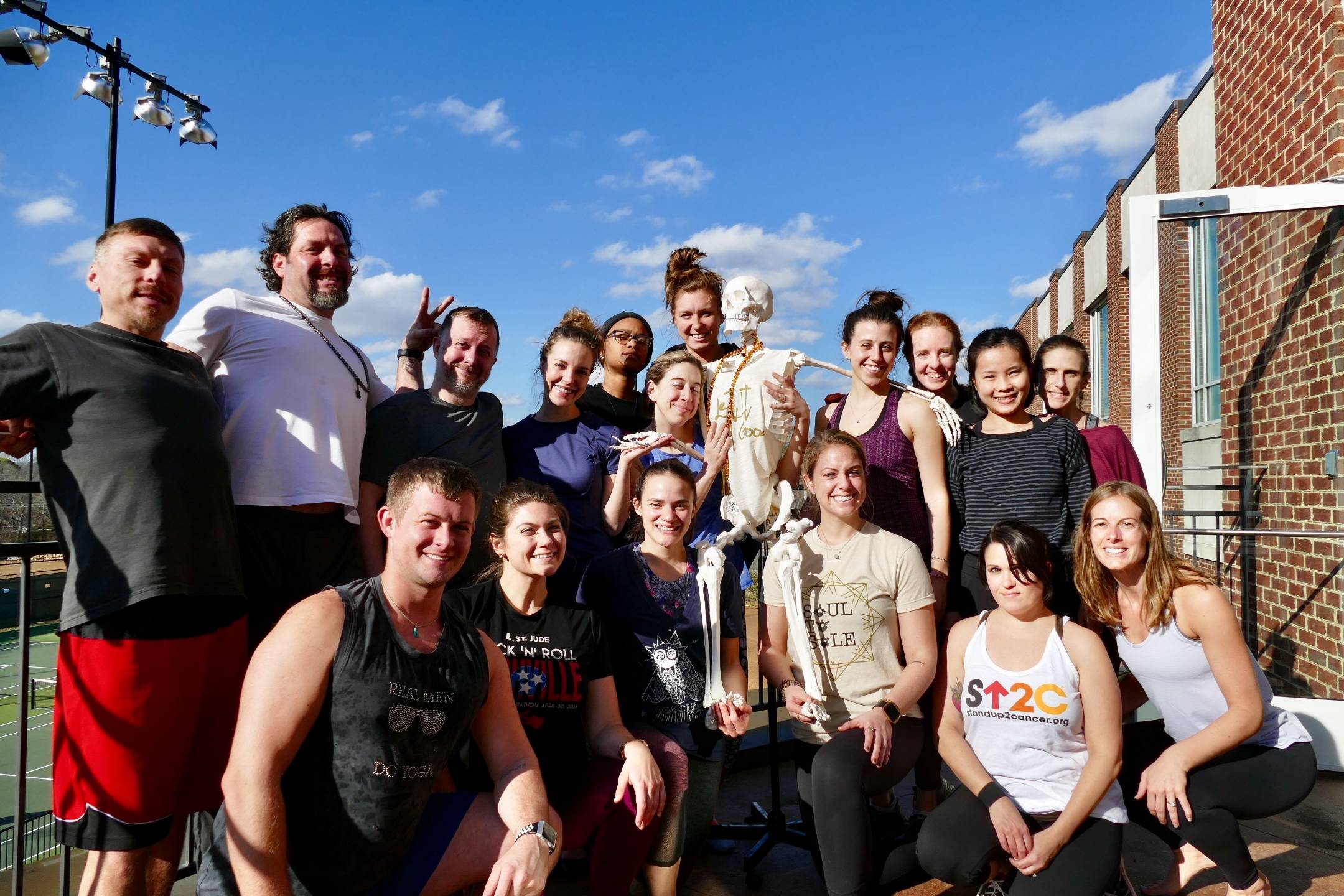
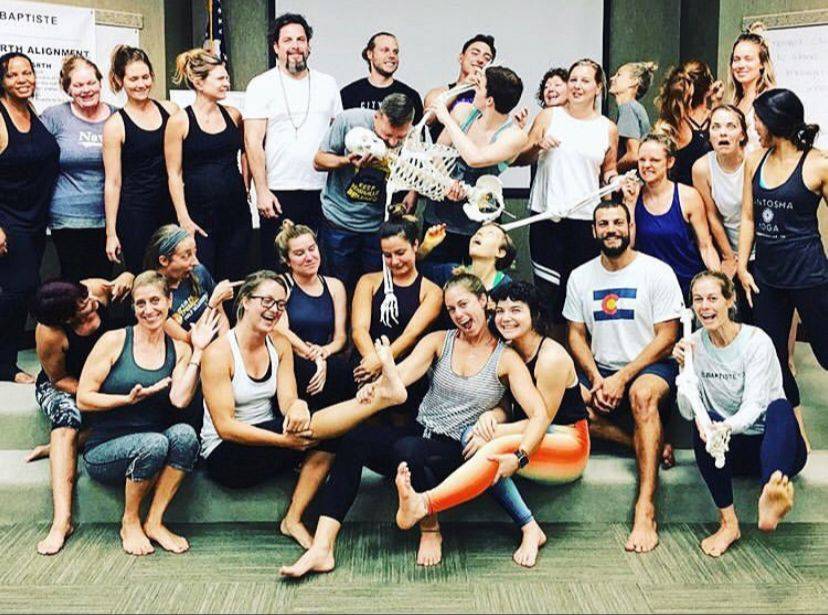
"Gabby has such a deep passion and sense of wonder for the human body and the way it works to support our daily lives. Her lecture was innovative and informative. She not only cultivated a curiosity for my students, the material landed quickly in their teaching." Misti JD, Owner, Pathfinder's Yoga YTT
"Gabby shows tons of modifications and different ways to access postures based off of different body types. My favorite take away from this course was teacher actions for addressing hyper- and hypo-mobile students. Gabby does a fantastic job at stopping for all teachable moments." Chris B., YTT Leader
Interested in licensing Anatomy 101 for your YTT, creating your own anatomy module, or a virtual or in-person Yoga Alliance–approved 12-hour anatomy done-for-you YTT module? Email Gabby at [email protected] and we'll walk through what that looks like for your program.
What students are saying
This course exceeded my expectations. The practical application of how this was taught will make me a much better and more effective yoga teacher. I learned how to look for weaknesses within my student's bodies to help them enhance their postures and avoid pain and harm. The best thing I learned in this training is how the fascia connects everything.
Dan B., YTT ParticipantGabby's teaching is detailed and specific, not esoteric. I was hoping to learn more about anatomy for yoga now that I have teaching experience, and her ability to teach anatomy from a yoga perspective was super helpful. Everything I learned was practical, applicable and effective.
Brooke W., YTT ParticipantIt has been 3 years since I was certified as a 200-hr RYT. The refresher course that she delivered was JUST what I needed to add additional knowledge to my original base during teacher training... I am now planning to retake the course that Gabby offers through Soul to Sole Wellness every couple of years.
Amanda J., Workshop ParticipantGabby taught us that things aren't always as they seem. Pain may be coming from the joint above and below, and it opened my eyes to seeing the body differently. She teaches total body integration, how the body is connected by fascia, but always relates it back to yoga and how we can use this information to be better, more effective yoga teachers.
Libby R., YTT ParticipantMeet your teacher
MEd, ATC, CES, E-RYT 200, YACEP
I'm Gabby DeLorenze, founder of Soul to Sole Wellness and co-founder of the Yoga Rehab Method.
I'm a Licensed and Certified Athletic Trainer with an MEd in Biomechanics, a Certified Exercise Specialist through NASM, and a Yoga Alliance registered E-RYT 200 and YACEP. For over a decade, I've split my time between clinical athletic training rooms and yoga studios, which means I've spent as much time rehabbing a rotator cuff as I have cueing one in a vinyasa class.
That combination is exactly why Anatomy 101 exists. Yoga was never meant to be about shoving the body into a shape. It's built on body autonomy and body awareness, and my job, whether I'm working with an athlete on a table or a room full of yoga teachers, has always been the same: help people actually feel their body working again, instead of just following a cue and hoping for the best.
I've taught anatomy and movement to well over 1,000 students, teachers, and clients, and the shift I watch happen over and over is the same one this course is built around: someone stops doing a certain pose a certain way and starts actually connecting to their glutes in their practice, and all their aches and pains start to get quiet.
Once you have the confidence to see that and call that out, you're teaching mind-body connection and really making an impact on your students.
Investment
This is a focused, 3-hour investment in a way of seeing the body that you'll use in every class you teach from here on.
Includes all 23 lessons, the full PowerPoint deck, the quiz, your Certificate of Completion, and lifetime access.
Enroll in Anatomy 101Unlimited access for your whole team of teachers, no enrollment cap: every lesson, the PowerPoint deck, and a quiz + certificate for each participant.
Get Anatomy 101 for Your StudioGood questions
Is this enough anatomy for my YTT, or do I need something more clinical?
Anatomy 101 is built specifically for teachers: functional, applied anatomy you can translate directly into cueing. If your program requires clinical-depth A&P certification hours, this is meant to complement that, not replace it.
I already have an anatomy background. Is this still useful?
Most students come in already certified. What this changes isn't what you know, it's how you see it in a moving body and how quickly you can turn that into a cue. If you've felt your anatomy knowledge go "flat" since certifying, this is built for exactly that.
Is this self-paced? What if I don't finish right away?
Yes. It's fully self-paced with lifetime access, so you can move through all 23 lessons in one sitting or return to specific modules whenever a student's question sends you back.
Can I use this inside my own YTT?
Yes, through our white-label licensing option: see the section above or reach out directly to talk through what that looks like for your program.
Is there a certificate?
Yes! You'll receive a Certificate of Completion after finishing the quiz. Also good for NASM Continuing Education.
What if it's not the right fit?
Try it for a week. If Anatomy 101 isn't landing for you, email us within 7 days of purchase for a full refund. No hoops.
Ready to see the body differently?
You already have the certification. You already have the students in front of you. This is the 3 hours that changes what you actually see when you're standing in front of them.
Building your own YTT and want to talk licensing instead? Get Anatomy 101 for your studio, $595, no enrollment cap.